
About the Regen10 Outcomes Framework
The global agrifood system sits at the centre of today’s interconnected crises. It both contributes to and is held back by systemic challenges, including geopolitical tensions and conflict, economic crises, water insecurity, accelerating climate change, biodiversity loss, land and ecosystem degradation, pollution, food insecurity, and growing income inequality (FAO, 2024). These pressures underscore the urgent need for actors to work together to transition towards solutions that address root causes and deliver durable, system-wide outcomes.
Regenerative agriculture, enabled by a wider regenerative agrifood system, can help us respond to and overcome these crises. When regenerative approaches are grounded in culturally appropriate and locally adapted practices and enabled by sound governance, market, and financial conditions, they can rebuild soil, protect water, support biodiversity, strengthen livelihoods, and produce nutritious food (Loring, 2022).
Crucially, regenerative approaches are not about reaching a fixed endpoint. Regeneration is a process of continuous renewal. As soils recover, biodiversity increases, and communities strengthen, positive feedback loops emerge that build ecological health, economic resilience, good governance, and social well-being over time. With sustained care and enabling conditions, these systems become more self-reinforcing and capable of adapting to shocks and stresses.
To achieve these outcomes, actors across the entire system need to collaborate urgently. Progress depends on scaling regenerative agrifood systems.
Interest in regenerative agriculture and landscape scale transitions has surged in recent years. However, there is still lack of consensus on what constitutes regenerative agriculture and regenerative agrifood systems, slowing down its ability to reach its potential. The scale of this potential must be unlocked. In a world where nearly 2.3 billion people face food insecurity (SOFI, 2025), the alignment of ecological integrity, economic viability, and food security across agrifood systems is not only strategic, but essential.
The Regen10 Outcomes Framework responds to this opportunity by offering a shared reference that focuses on outcomes. The Framework supports coordination, accountability, and adaptive management without imposing uniformity. It creates a shared direction for uniting diverse actors and approaches across scales and dimensions, enabling lasting, transformational change of agrifood systems.
What is the Regen10 Outcomes Framework?
The Regen10 Outcomes Framework offers a holistic view of regenerative agrifood systems, defining the full scope of regenerative outcomes across ecological, social, economic, and governance dimensions, and across farm and landscape scales. Rather than being a certification, assessment methodology, or compliance tool, it serves two core use cases:
- Creating a shared vision and understanding: It provides a common reference point for what regenerative agriculture and regenerative agrifood systems means across diverse actors, enabling alignment without prescribing uniform approaches.
- Supporting legitimacy in tools and claims: It acts as a shared credibility reference for standards, assessments, and claims, enabling actors to evaluate alignment and completeness over time against a common outcome structure.
At its heart, the Outcomes Framework recognizes farmers, farm workers, Indigenous Peoples, local communities, and other land stewards as rights-holders and essential stewards of biocultural landscapes. Their traditional knowledge systems and governance practices are critical for interpreting, prioritizing, and contextualizing outcomes. The Framework also acknowledges the essential role of farm workers, whose labor, skills, and working conditions are integral to social sustainability and equitable value creation.
The Outcomes Framework reflects several distinct attributes:
First, it is centered on an outcome-based approach. It does not dictate ‘how to farm’ and instead, describes what success looks like when regenerative agriculture is working (e.g., healthy soils, improved ecosystem integrity, food security, and resilient livelihoods). By focusing on outcomes rather than practices, the Framework recognizes that the context in which farmers produce food, fuel and fiber differs across the world, and enables them to apply context-appropriate strategies while remaining accountable to shared expectations of what regeneration should achieve. This approach complements and can be paired with practice-based frameworks. It is designed to support alignment and interoperability across actors and tools, without imposing a single pathway.
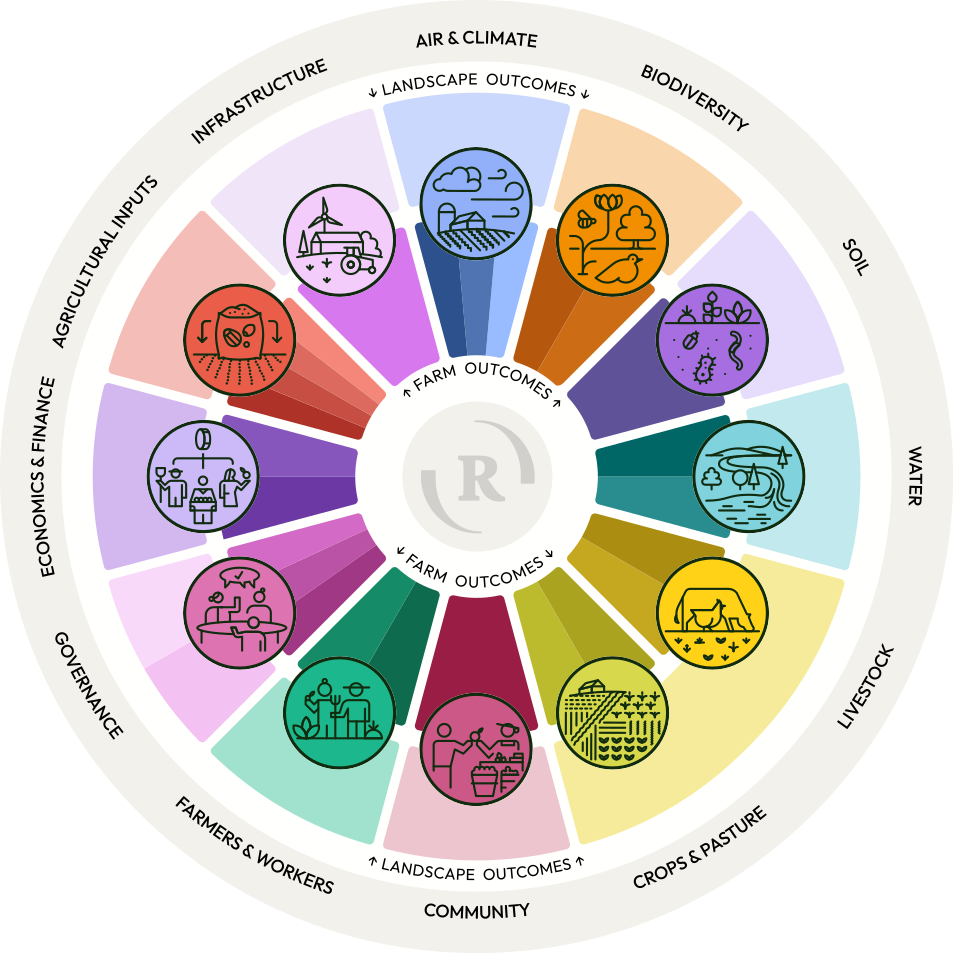
Secondly, the Outcomes Framework takes a systems perspective, recognizing the two-way dependency between farm and landscape levels. Regenerative landscape-level outcomes provide the necessary enabling conditions for regenerative farm-level outcomes, while cumulative farm-level outcomes shape the health and resilience of landscapes. This reflects ecological reality: soil functions, hydrological flows, biodiversity dynamics, and climate processes operate across farm boundaries and require coordination at landscape scale.
- Farm-level outcomes describe what regenerative farms look like as well as connecting them to the broader systems in which they operate.
- Landscape-level outcomes describe what regenerative landscapes look like, and bridge interactions at sub-national, national, and global scales.
- Across both levels, twelve interconnected dimensions span air and climate, biodiversity, soil, water, livestock, crops and pasture, community, farmers and workers, governance, economics and finance, agricultural inputs, and infrastructure.
- While agriculture operates within wider agrifood systems, the Framework focuses on agricultural production landscapes and the ecological, social, economic, and governance conditions that enable regeneration within them.
Finally, the Framework also includes illustrative indicators to support its implementation. These indicative and non-exhaustive indicators can be used to provide a snapshot of the system at a point in time, and, most importantly, used repeatedly to assess long-term progress. Indicator selection and measurement methodologies should be tailored to the setting, governed by stakeholders, and proportionate to available data, data collection systems, and resources.
How was the Framework developed?
The Regen10 Outcomes Framework is the product of a long-term, collaborative process, involving many committed organizations and partners.
Its development was led by Regen10 partners, beginning with a review of over 150 existing frameworks that identified the Global Farm Metric, developed by Sustainable Food Trust, as the most holistic and outcome-based farm-level starting point. From there, the Framework was built outward through farm trials, expert review, landscape partners, and multiple cross-sectoral consultation cycles across regions.
This was not a process where consensus was pre-existing – it was deliberately built. The Framework reflects what emerged: a negotiated, multi-perspective articulation of what regenerative agrifood systems should deliver, grounded in the priorities of diverse actors, rather than a single sector’s.

Who is The Regen10 Outcomes Framework for?
The Regen10 Outcomes Framework serves a diverse range of actors involved in accelerating regenerative agriculture and regenerative agrifood systems, each with distinct roles, responsibilities, and levels of influence in enabling farm- and landscape-level regeneration.
Farmers and land stewards are invited to use the Regen10 Outcomes Framework to identify what regenerative outcomes look like, informing on-farm decisions, and engage more confidently with value chain partners, buyers, investors, and programs. In practice, most farmers will engage with the Framework through intermediaries – extension workers, farmer organizations, buyers, and programs – who translate outcomes into actionable, context-specific guidance and assessments. The Outcomes Framework can also help farmers make the added value of regenerative agriculture visible across the value chain, supporting recognition of their efforts and more effective price negotiation. In doing so, it helps them articulate what they need from the systems around them - fair markets, secure tenure, and accessible finance - to make farm-level regeneration viable and doable.
Landscape partnerships and coalitions are invited to use the Regen10 Outcomes Framework to align diverse stakeholders around shared outcomes, prioritize actions, navigate trade-offs across ecological, social, and economic objectives, and design transition strategies that address both farm-level practices and system-level conditions. In 2026, Regen10 is testing this directly in Kenya and Brazil - applying the Framework to ground regenerative landscape transition planning in locally defined priorities before measurement approaches are defined.
Companies and supply chain actors are invited to use the Regen10 Outcomes Framework to ground sourcing strategies and supplier engagement in clearly defined outcomes, communicate consistent expectations, and assess whether their programs, sourcing models, incentives across value creation and distribution, pricing and contracting, risk-sharing arrangements, and long-term commitments are meaningfully contributing to credible and resilient regenerative transformation, rather than externalizing costs or risks elsewhere in the system.
Funders and investors are invited to use the Regen10 Outcomes Framework to design programs and instruments that target meaningful outcomes and mitigate risk, evaluate alignment across their portfolios, and support coherence rather than fragmentation in the initiatives they fund. By aligning capital with shared outcomes, funders and investors can reduce fragmentation, discourage short-term or single-issue interventions, and support more durable system change.
Policymakers and public agencies are invited to use the Regen10 Outcomes Framework to inform national strategies, align public programs with regenerative outcomes, and create enabling conditions for farm and landscape-level transformation. Public agencies can also use it to manage and mitigate public risk (e.g., land degradation, biodiversity loss, and food security) by aligning incentives and safeguards with regenerative outcomes. Many regenerative outcomes, such as biodiversity conservation, climate stability, and water security generate widespread societal benefits that markets alone tend to underprovide, therefore requiring public leadership alongside private action.
Standards developers and assessment tools are invited to use the Regen10 Outcomes Framework as a reference structure, mapping their indicators to shared outcomes, improving interoperability, and strengthening the credibility of their approaches.
Intermediaries and technical partners, including farmer organizations, extension services, agronomists, consultants, and researchers, are invited to play a critical role in applying outcomes to context-specific practices through assessments and guidance. Farmers make daily decisions, so a trusted facilitator may support farmers to bridge that gap from systems theory to locally relevant practice. Regen10 provides the shared reference point, while intermediaries translate outcomes into context-specific guidance that supports, rather than replaces, local decision-making.

How actors are already using it
The Regen10 Outcomes Framework supports multiple pathways. There is no one-size-fits-all model of regeneration. Actors engaging with the Outcomes Framework will be at different starting points, and that is expected. A smallholder cooperative in Kenya, a multinational sourcing company, a landscape coalition in Brazil, and a government designing national policy all face different constraints, capacities, and entry points. The Framework does not require everyone to start in the same place, and it is already shaping how organizations approach regenerative transitions. This flexibility allows diverse actors to engage from their own contexts while still aligning with a shared definition of what regenerative outcomes should deliver over time.
One Acre Fund has used the Regen10 Outcomes Framework to build an indicator package for the millions of smallholder farmers they work with across sub-Saharan Africa. It has helped guide organizational strategy and align internal country teams around shared outcomes while allowing context-specific measurement, with annual reporting against selected indicators.
LandScale has developed a regenerative agriculture assessment lens for their landscape-level assessment tool, directly referencing the Regen10 Outcomes Framework. This enables landscape initiatives using LandScale to assess progress against outcomes that connect farm and landscape levels.
Rare has drawn on the Regen10 Outcomes Framework to develop an indicator package for their regenerative agriculture work in Colombia, grounding their program design in outcomes that reflect both ecological and social dimensions.
These examples illustrate the Regen10 Outcomes Framework's core function: providing a shared reference that diverse actors can adapt to their contexts without starting from scratch.
Connection to other initiatives
The Regen10 Outcomes Framework does not exist in isolation. Today’s regenerative ecosystem includes business implementation frameworks, landscape and farm assessments, certifications, and standards, each designed to serve different actors and purposes. What many actors have called for is a shared upstream reference for what regenerative agrifood systems can achieve across environmental, social, and governance dimensions. The Outcomes Framework fills this gap by offering a multi-stakeholder–validated, outcomes-based reference that clarifies regenerative agrifood systems’ long-term aspirations, while allowing initiatives to retain their own methodologies, tools, and scope.
Alignment in this context does not mean uniform metrics or approaches, but coherence around shared outcomes and long-term ambition. Not to be misread as standardization, Regen10 is collaborating with partner initiatives like SAI Platform, WBCSD, LandScale, 1000 Landscapes for 1 Billion People, and others to formalize how their work connects to shared outcomes. Regen10 does not assess, rank, or endorse individual tools or initiatives, but provides a common reference that supports transparency and comparability across the ecosystem.
Regen10 is developing "Regenerative Journey" practical guidance to support engagement of actors at different stages in varying contexts. The purpose of this guidance is to help different actors engage with the Framework in a credible and context-appropriate way over time, clarifying what deeper regenerative engagement looks like without prescribing implementation methods or creating compliance thresholds.
Together, the Regen10 Outcomes Framework and Regenerative Journey guidance strengthen coherence, integrity, and credibility across the regenerative agriculture ecosystem while preserving flexibility for diverse contexts.
In 2026, Regen10 will also publish an ecosystem guide mapping how initiatives across the regenerative agriculture landscape connect - from implementation tools and landscape assessments to certifications, standards, and disclosure frameworks. The guide will aim to help actors understand where different tools sit, how they relate to one another, and where the opportunities for stronger coordination lie.
An invitation
The Regen10 Outcomes Framework reflects years of collaborative development - listening, debating, refining, and testing across diverse contexts and perspectives. It is designed for farmers and landscape stewards, landscape partners and coalitions, companies and supply chain actors, funders and investors, policymakers and public agencies, standards and tools developers, intermediaries and technical partners. The Outcomes Framework is meant to evolve, guided by a reflective approach to monitoring, evaluation, and learning, so that it grows alongside our collective insights and innovations. It enables accountability through transparency and alignment around shared outcomes, providing a credible reference point that supports ambition, comparability, and integrity across regenerative efforts.
Now, the Framework is ready to be used, shared, and put into action. Its potential is real, offering a common foundation to align the growing energy around regenerative agrifood systems toward outcomes that matter - for farmers, communities, ecosystems, and the food systems we all rely on.
The Regen10 Outcomes Framework provides that foundation. Engagement can take many forms, from aligning strategies and tools with shared outcomes to using the Framework to guide dialogue, design, and decision-making across scales. We invite you to use, test, and share learning back to evolve this Framework together so that regenerative ambition translates into durable, real-world change.
References
De Matteis, L., Mattioni, D., Garcia Campos, P., Ilie, E. T., Wiegers, E., & Hawkes, C. (2025). International experiences of systems approaches: Re-thinking policies and governance to transform agrifood systems. Philosophical Transactions of the Royal Society B: Biological Sciences, 380(1935), Article 20240159. https://doi.org/10.1098/rstb.2024.0159
Food and Agriculture Organization of the United Nations. (2024). The State of Food and Agriculture 2024: Value-driven transformation of agrifood systems (SOFA Report). Food and Agriculture Organization of the United Nations. https://doi.org/10.4060/cd2616en.
Global Alliance for the Future of Food. (2024). Cultivating change: A collaborative philanthropic initiative to accelerate and scale agroecology and regenerative approaches (Report). https://futureoffood.org/wp-content/uploads/2024/05/GA_CultivatingChange_Report_052124.pdf.
Loring, P. A. (2022). Regenerative food systems and the conservation of change. Agriculture and Human Values, 39(2), 701–713. https://doi.org/10.1007/s10460-021-10282-2.
Scherr, S. J., Buck, L. E., & Granados, B. (2025). A strategy for transforming food systems through regenerative landscapes (White paper). EcoAgriculture Partners on behalf of 1000 Landscapes for 1 Billion People & Meridian Institute on behalf of Regen10. https://regen10.org/wp-content/uploads/2025/03/Report_A-Strategy-for-Transforming-Food-Systems-through-Regenerative-Landscapes.pdf.
United Nations. (2021). UN Food Systems Summit: Transforming food systems for the 2030 Agenda. United Nations. https://www.un.org/en/food-systems-summit (2021 summit overview).
United Nations Secretary-General. (2023). Making food systems work for people and planet: UN Food Systems Summit +2 stocktaking report (Report of the Secretary-General). UN Food Systems Coordination Hub. https://www.unfoodsystemshub.org/docs/unfoodsystemslibraries/stocktaking-moment/un-secretary-general/sgreport_en_rgb_updated_compressed.pdf (UNFSS+2 official report).